Knee Pain Treatment
Knee Pain Treatment in Denver
Evidence-Based Care at Denver Spine & Performance
Knee pain is one of the most common complaints among active individuals, runners, and athletes. Whether it develops from overuse, improper mechanics, or injury, knee pain can limit performance and interfere with everyday movement.
At Denver Spine & Performance, we specialize in diagnosing and treating mechanical knee pain using a combination of advanced movement assessment, hands-on care, and progressive rehabilitation. Our goal is not only to relieve your pain but also to identify the root cause so you can return to an active, healthy lifestyle without recurring flare-ups.
Understanding Knee Pain
Understanding the Knee Joint
The knee is a hinge joint that allows bending (flexion) and straightening (extension), but it also relies on subtle rotational and stabilizing forces to function efficiently. It plays a critical role in absorbing impact and transferring force between the hip and ankle during movement.
Because of this, the knee depends heavily on surrounding structures for both mobility and stability. When these systems are not working together properly, the knee often becomes overloaded—leading to irritation and pain.
Knee Joint Anatomy
- Bones (Femur, Tibia, Patella)
- Cartilage & Meniscus
- Ligaments (ACL, PCL, MCL, LCL)
- Muscles (Quadriceps, Hamstrings, Calves)
Mechanical Knee Pain
Understanding Knee Pain
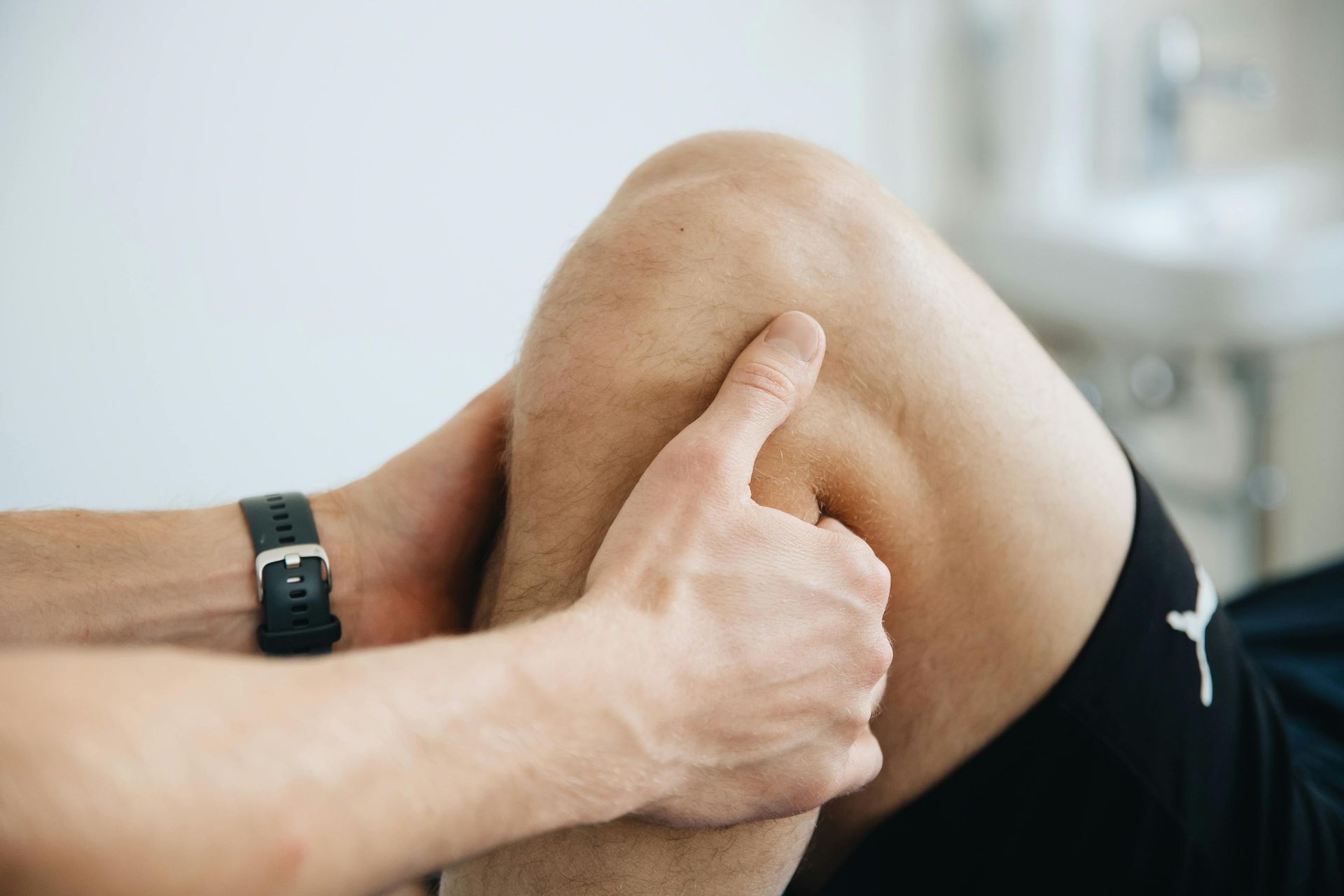
Mechanical knee pain is the most common type of knee discomfort and typically arises from irritation of the joint, surrounding soft tissues, or improper loading patterns—rather than acute structural damage. It often develops gradually over time, especially in active individuals, runners, and those performing repetitive movements.
Patients commonly report:
- Pain with bending, squatting, lunging, or going up and down stairs
- Discomfort during or after workouts, running, or prolonged activity
- Clicking, popping, or a sensation of stiffness within the knee
- Pain that improves with rest but returns when activity resumes
Kinetic Chain Considerations
The knee does not function in isolation—it is highly dependent on the joints above and below it. Because of this, knee pain is often a symptom of dysfunction elsewhere in the body rather than the primary problem.
Key contributors include:
- Hip Strength and Control: Weak or poorly coordinated hip musculature (especially the glutes) can lead to poor knee alignment and increased joint stress during movement
- Ankle Mobility: Limited ankle dorsiflexion can force compensations at the knee, especially during squatting, running, and landing
- Movement Patterns: Inefficient or asymmetrical movement strategies—often developed over time—can overload the knee and perpetuate pain
At
Denver Spine & Performance, we take a
full-body, movement-based approach by evaluating how the hip, knee, and ankle work together during real-world activities. This allows us to identify the true source of dysfunction, correct movement inefficiencies, and create lasting improvements—so you can return to training and daily activity without recurring pain.
Knee Pain Conditions We Treat
Common Conditions
- Patellofemoral Pain Syndrome
- Runner’s Knee
- Tendonitis (Patellar/Quad)
- IT Band Syndrome
- Meniscus Irritation
- Ligament Sprains
- Chronic Knee Pain
- Post-Activity Knee Pain
Knee Pain Treatment at Denver Spine & Performance
1. Root Cause Diagnosis
We perform a detailed assessment to identify:
- Movement limitations
- Joint dysfunction
- Strength and stability deficits
- Nervous system involvement
This allows us to determine whether your pain is mechanical, nerve-related, or a combination of both.
2. Integrated Treatment Approach
Your care plan may include:
- Targeted manual therapy to reduce pain and improve mobility
- Progressive strength and stability training
- Movement retraining specific to your lifestyle or sport
- Nerve mobility techniques for radiculopathy
Evidence supports that combining manual therapy with active rehabilitation can improve pain and function in spine-related conditions.
3. Performance-Focused Rehabilitation
We don’t stop at pain relief. Our goal is to:
- Restore full movement capacity
- Build strength through the spine and surrounding structures
- Improve resilience to prevent recurrence
Whether you’re an athlete, active adult, or working professional, your program is tailored to your demands and goals.
4. Education & Long-Term Strategy
You’ll leave every session understanding:
- What’s causing your pain
- How to manage it effectively
- What to do and how to prevent flare-ups
This empowers you to take control of your recovery—not rely on ongoing passive care.
Knee Pain Treatment in Denver, CO — Get Started
At Denver Spine & Performance, we specialize in helping active individuals overcome knee pain and return to high-level function—without unnecessary imaging, medications, or long-term passive care.
If you’re ready to address the root cause of your pain and get back to performing at your best, we’re here to help.
Book Your Initial Evaluation Today
- Personalized assessment
- Clear diagnosis
- Customized treatment plan
Knee Pain is just one of the many conditions we treat at Denver Spine & Performance.
Contact us today at 303.758.1100 for an individualized plan of care.